
Keep Your Home Clean: How Artificial Turf Prevents Mud
How Artificial Turf Prevents Mud in Your Home by SportZturf
Artificial turf, also called synthetic grass or fake grass, replaces exposed soil and natural turf with a stable, permeable surface that diverts water and prevents mud from forming where families and pets walk. This article explains how synthetic turf prevents indoor mud tracking by combining engineered drainage, a durable surface layer, and a properly prepared sub-base that together eliminate the common sources of muddy footprints. Readers will learn the physical causes of mud on natural lawns, the drainage and surface mechanisms that make artificial turf effective, the benefits for cleaner homes and allergen control, pet- and child-focused solutions, and the installation and upkeep practices that sustain performance. Practical guidance and side-by-side comparisons (including component tables and maintenance recommendations) are included so homeowners can evaluate turf systems, plan transition zones, and reduce indoor cleaning burdens. The following sections map the problem to solutions: causes of mud with natural grass, how synthetic turf stops mud, the key home-cleanliness benefits, pet- and family-focused solutions, and the installation and maintenance checklist that ensures lasting mud prevention.
Natural mud starts in the yard, and managing that source is the most effective way to keep floors clean. The next section explains the root causes of mud formation on natural lawns and why those same conditions lead to tracked-in dirt inside the home.
What Causes Mud Problems in Homes with Natural Grass?
Mud problems in houses usually begin outdoors when soil becomes saturated and breaks down under foot traffic, creating transferable mud that sticks to shoes and paws. Saturation happens when soil retains more water than it can drain, while compaction and poor grading increase puddling and prolong wet conditions; this combination yields surfaces that smear across entryways. High-use areas near doors, pet runs, and play spaces accelerate turf breakdown and expose soil, multiplying the amount of mud transferred indoors. Understanding these causes clarifies why covering or replacing soil with a stable, permeable surface can stop indoor mud at its source by preventing saturation and protecting the ground cover.
Common causes of yard mud include soil type, poor slope or grading, and concentrated traffic that damages turf and exposes bare earth. The next subsection explains how water and soil interact to form mud and what homeowners can identify in their yards.
How Do Soil and Water Interact to Create Mud?
Soil and water create mud when the soil’s pore structure reaches saturation and loses internal cohesion, turning firm ground into a smearable surface. Clay-rich soils hold water and stay saturated longer, meaning puddles and soft ground persist after rain, while sandy soils drain more quickly and are less likely to create sticky mud. Compaction reduces pore space and raises the soil’s saturation point, so even light rain can produce mud on compacted areas. Homeowners should recognize that improving drainage or replacing exposed soil with permeable coverings reduces the duration and extent of saturation and therefore the opportunity for mud to form.
A clear grasp of soil behavior helps target interventions at the micro-level, which leads into why pets and children increase the scale of indoor mud transfer.
Why Do Pets and Children Increase Mud Tracking Indoors?
Pets and children amplify mud tracking through repetitive, high-energy contact with the ground that breaks down vegetation and exposes soil, creating concentrated mud sources. Dogs dig, run in wet patches, and return to the house with muddy paws, while children often play in low spots and along pathways that collect water, bringing soil indoors on shoes and clothing. High-frequency use of the same routes compacts the soil and removes grass cover, producing persistent mud-prone corridors right at entry points. Addressing these behavior-driven patterns with durable surface solutions and transition zones reduces repeat transfer and protects interior floors.
Mitigating these user-driven causes requires a surface solution that prevents soil exposure and accelerates surface drying, which is the mechanism artificial turf provides and which the next section describes.
How Does Artificial Turf Stop Mud from Entering Your Home?

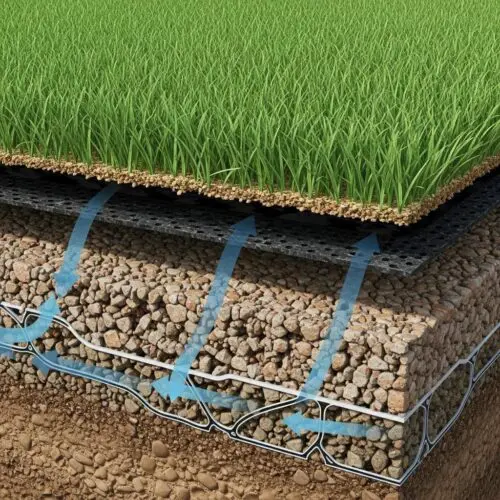
Artificial turf prevents mud from entering homes by removing exposed soil, providing a stable synthetic surface that sheds water through a permeable backing and an engineered sub-base, and resisting surface abrasion that would otherwise expose earth beneath. The turf system acts as a barrier and a drainage pathway: water passes through turf fibers and permeable backing into an aggregate base, where it disperses laterally or percolates into natural ground, eliminating standing puddles that create mud. Durable fibers and appropriate infill reduce digging and wear, maintaining continuous coverage even in high-traffic areas used by pets and children. Together these mechanisms stop the causal chain—no exposed soil means no mud to track indoors.
Below are the primary mechanism steps that summarize how synthetic grass controls mud:
- Permeable surface and backing direct water away from the top layer and into the base.
- Aggregate sub-base stores and conveys runoff, preventing surface pooling and saturation.
- Stable turf fibers and infill prevent soil exposure and reduce material that can adhere to paws and shoes.
These components work in concert to keep entryways and play areas dry, which the following table compares in more detail.
| Component | Characteristic | Contribution to Mud Prevention |
|---|---|---|
| Permeable backing | Drainage holes/perforations | Allows rapid water passage from surface into base, preventing puddles |
| Infill | Sand or polymer granules | Stabilizes fibers, reduces wear, and lowers soil exposure from digging |
| Aggregate sub-base | Crushed stone layer | Stores and transports water away from surface, increases permeability |
| Geotextile membrane | Filtration layer | Prevents fines migrating into base, maintaining drainage capacity |
A practical summary: choose systems with permeable backing, a well-graded aggregate base, and dense fibers with suitable infill to stop outdoor mud before it reaches the threshold and becomes an indoor cleaning problem.
What Role Does the Artificial Grass Drainage System Play?
The drainage system in an artificial turf installation governs how quickly water leaves the surface and therefore how long the area stays wet enough to create mud. Perforated or porous backing allows surface water to pass through turf fibers into the sub-base, where the aggregate layer conveys water away or holds it until it infiltrates nearby soil; this rapid bypass of surface flow prevents puddling. Properly designed drainage reduces saturation time, which in turn minimizes the window when mud can form and be tracked inside. Evaluating drainage performance often focuses on the permeability of the backing and the depth and composition of the aggregate sub-base.
When installers design the drainage path correctly, water moves away from doors and high-traffic areas, which limits the formation of mud at entry points and improves surface drying after storms.
How Does Eliminating Exposed Soil Prevent Mud Formation?
Eliminating exposed soil removes the fundamental material that turns into mud when wet, making it impossible for saturated earth to be smeared and tracked into the home. A continuous artificial surface separates foot and paw traffic from underlying soil, preventing direct displacement of fine particles and inhibiting mud adhesion to fur and soles. Even during prolonged wet periods, a properly installed turf system maintains a functional walking surface because water is channeled away rather than saturating the top layer. Covering or replacing vulnerable pathways and play areas therefore breaks the chain from wet soil to indoor mess.
Converting vulnerable spots to synthetic turf is a direct source-control strategy: remove the mud source outdoors and reduce the cleaning load indoors.
What Are the Key Benefits of Using Synthetic Turf for a Cleaner Home?
Synthetic turf delivers multiple clean-home benefits by cutting the volume of mud produced outdoors, suppressing dust and soil aerosolization, and simplifying after-use cleanup routines that keep floors and entryways cleaner. With fewer muddy paws and clinging dirt particles, homeowners experience less vacuuming and mopping, quicker drying times after rain, and reduced transfer of allergens that attach to soil. Artificial grass also resists staining and maintains a uniform surface, which reduces the frequency of intensive yard repairs that otherwise expose soil. These outcomes combine to lower interior maintenance time and create a more consistent threshold between outdoors and indoors.
| Turf Type | Key Attribute | Typical Outcome |
|---|---|---|
| Pet turf | Fast-draining backing and easy-rinse infill | Reduces muddy paws and simplifies pet cleanup |
| Residential synthetic turf | Dense fiber profile and moderate infill | Fewer tracked footprints and quick surface drying |
| Drainage-optimized turf systems | Permeable backing + deep aggregate base | Minimizes puddling and long-term saturation near entries |
| Backyard artificial lawn | Recreation-focused fibers | Stable play surface with reduced soil exposure |
The tangible benefits include fewer muddy entryways, less dirt migration into living spaces, and simpler outdoor cleaning procedures, which together reduce household cleaning time and protect indoor surfaces.
- How synthetic turf reduces muddy paws and footprints:Rapid Drainage: Permeable backing and an aggregate base move water away from the surface quickly, limiting mud adhesion.Stable Surface: Dense fibers and proper infill create a firm walking surface that prevents soil displacement.Easy Rinse: Turf surfaces can be hose-rinsed and spot-cleaned, removing residual dirt before pets or people enter the home.
These benefits show why artificial turf is effective for controlling common vectors of indoor mud and inform the next section, which focuses on pets and families.
How Does Artificial Turf Reduce Muddy Paws and Footprints?
Artificial turf reduces the amount of mud that clings to paws and shoes by limiting exposed, saturated soil and by expediting surface drying, which lowers the time window when particles adhere. Dense fiber constructions and suitable infill systems create texture that resists clinging mud and sheds debris, while the underlying drainage moves water away from the surface, preventing puddles where mud forms. For pet owners, pairing turf with a simple rinse station or wipe zone at doors keeps residual dirt from crossing the threshold. Implementing those transition steps multiplies the turf’s mud-control effectiveness and shortens indoor cleaning routines.
Reducing adherence at the source also decreases the frequency of deep-cleaning events, which helps maintain both yard appearance and household cleanliness.
In What Ways Does Artificial Grass Lower Dirt and Allergen Tracking?
Artificial grass lowers dirt and allergen tracking by removing bare soil that generates dust and pollen and by providing a surface that is easier to clean than vegetation and bare earth. With no loose topsoil to be aerosolized by wind or foot traffic, airborne dust loads decrease and pollen that would normally settle into soil can be rinsed from the turf surface. Routine rinsing and brushing remove accumulated particles before they are transferred indoors, and the absence of mud stains simplifies laundering of entryway mats and pet bedding. These advantages support households with allergy sensitivities and reduce the overall indoor exposure to soil-derived particulates.
By limiting the source of dust and enabling straightforward cleaning, synthetic turf reduces one of the principal pathways by which outdoor allergens enter indoor spaces.
How Artificial Turf Prevents Mud in Your Home by SportZturf
Artificial turf offers targeted solutions for pet owners and families by combining pet-focused turf features—such as odor-control infill and antimicrobial options—with consistent, quick-dry play surfaces that limit mud, stains, and slips. For animals, fast drainage and easy-rinse surfaces reduce mud accumulation and simplify waste cleanup, while dense fibers help prevent digging from exposing soil. For children, uniform surfaces reduce slip hazards and staining from wet play areas; additional cushioning layers can be added under turf where play equipment sits to enhance safety. Creating entry transition zones and wipe stations further minimizes indoor transfer and preserves clean floors.
Choosing system attributes that align with household use patterns makes turf an effective preventive measure that complements behavioral strategies like designated play paths and pet cleaning routines.
Why Is Pet Turf a Mud Solution for Dogs and Other Animals?
Pet-specific turf is designed to handle frequent animal activity by prioritizing rapid drainage, durable fibers, and infill choices that limit odor and mud retention. The combination of permeable backing and an aggregate sub-base prevents accumulation of puddles in pet run areas and reduces the residual moisture that causes muddy paws. Antimicrobial or odor-control infill materials ease sanitation and, when paired with routine rinsing, keep surfaces hygienic and mud-free. Pet turf therefore tackles both the mechanical cause (digging and wear) and the moisture pathway that leads to mud, making it a practical solution for dog yards and high-use animal areas.
When owners integrate a simple rinse or wipe step at the door, the net effect is a significant drop in indoor mud and associated odors.
How Does Artificial Grass Create Safe, Mud-Free Play Areas for Children?
Artificial grass creates safe, mud-free play areas by providing a consistent, dry surface that reduces slipping and staining while supporting rapid recovery after wet weather. Turf options that include shock-absorbing underlayers or engineered infills can meet playground safety needs while the permeable system beneath drains surface water quickly. Because the surface resists soil displacement, play equipment and pathways remain cleaner and require less maintenance after use. Pairing turf with appropriate grading and entry transition zones ensures that play areas stay usable and tidy, which reduces indoor messes from playdates and sports activities.
Designing play spaces with both safety and cleanliness in mind maximizes the turf’s value for families with active children.
What Installation and Maintenance Practices Ensure Optimal Mud Prevention?
Optimal mud prevention depends on installation choices—grading, sub-base composition, permeable backing selection—and on ongoing maintenance routines that keep drainage pathways clear and fibers upright. A correct installation directs water away from foundations and entry points via slope and an adequately sized aggregate base, while geotextiles and proper compaction stabilize the sub-base to prevent future settlement. Maintenance tasks such as regular brushing, rinsing after heavy use, and debris removal sustain permeability and the turf’s appearance over time. Homeowners should prioritize these installation and upkeep practices to ensure the system continues to prevent mud rather than temporarily masking the problem.
- Installation and setup checklist for mud prevention:Grade away from structures: Ensure surface slopes direct water away from doors and foundations.Specify aggregate sub-base: Use a well-graded crushed stone layer of sufficient depth for local drainage needs.Choose permeable backing: Select turf with drainage capacity and perforations appropriate for expected runoff.Install geotextile where needed: Prevent base contamination and preserve long-term permeability.Compact correctly: Achieve uniform compaction to avoid future settling and pooling.
| Base Option | Characteristic | Recommendation |
|---|---|---|
| Compacted aggregate | High permeability, stable | Use for most residential installs; compact in layers to avoid settlement |
| Sand layer over base | Smoother profile, moderate drainage | Use with caution; combine with sufficient aggregate depth for drainage |
| Geotextile + aggregate | Filtration + conveyance | Recommended in areas with fines to protect drainage longevity |
After installation, follow a simple maintenance schedule to ensure continued performance and address minor issues before they become sources of pooling or mud.
How Does Proper Base Preparation and Grading Enhance Drainage?
Proper base preparation and grading create the conveyance pathways for water that prevent surface saturation and mud formation. Sloping surfaces away from the house—generally a modest gradient of about 1-2%—encourages runoff toward landscaped drains or permeable areas, while a well-built aggregate base stores and directs water away from the turf surface. Layered compaction prevents uneven settlement that can create low spots and pooling, and geotextiles minimize migration of fine particles that would degrade the base’s permeability. Paying close attention to these design details during installation ensures the turf functions as intended and maintains a dry, mud-free surface under routine use.
Good base work also reduces long-term maintenance needs by preventing the formation of localized wet zones that could otherwise generate mud.
What Are the Best Maintenance Tips to Keep Artificial Turf Mud-Free?
Routine maintenance preserves drainage, appearance, and the turf’s ability to deny mud formation by keeping fibers clear and the base functioning properly. Regular tasks include brushing fibers to maintain upright orientation and permeability, rinsing areas after heavy pet use or muddy weather, and promptly removing leaves and debris that can trap moisture. Inspecting for localized compaction or washouts and addressing them—through light aeration or re-leveling the base—prevents pooling from developing into persistent muddy patches. A seasonal inspection that verifies drainage outlets remain unobstructed and that infill levels are appropriate will sustain the mud-prevention benefits over years of use.
Consistent maintenance is the operational counterpart to correct installation: both are required to keep mud out of the house.
- Recommended maintenance schedule summary:Weekly: Remove debris and brush high-traffic paths to keep fibers upright.After heavy rain or use: Rinse areas and check for pooling or compaction.Annually: Inspect base stability and top up infill if needed to preserve surface resilience.
Following this schedule maintains permeability and minimizes the chance that a turf system becomes a temporary solution rather than a permanent mud-control strategy.
This final implementation guidance ties installation quality to routine maintenance to ensure that artificial turf continues to prevent mud from entering your home reliably and with minimal disruption.